DBT Skills Group for Teens in Hillsboro, OR
Teenagers can experience emotions, stress, relationships, and everyday challenges with an intensity that can sometimes feel difficult to manage.
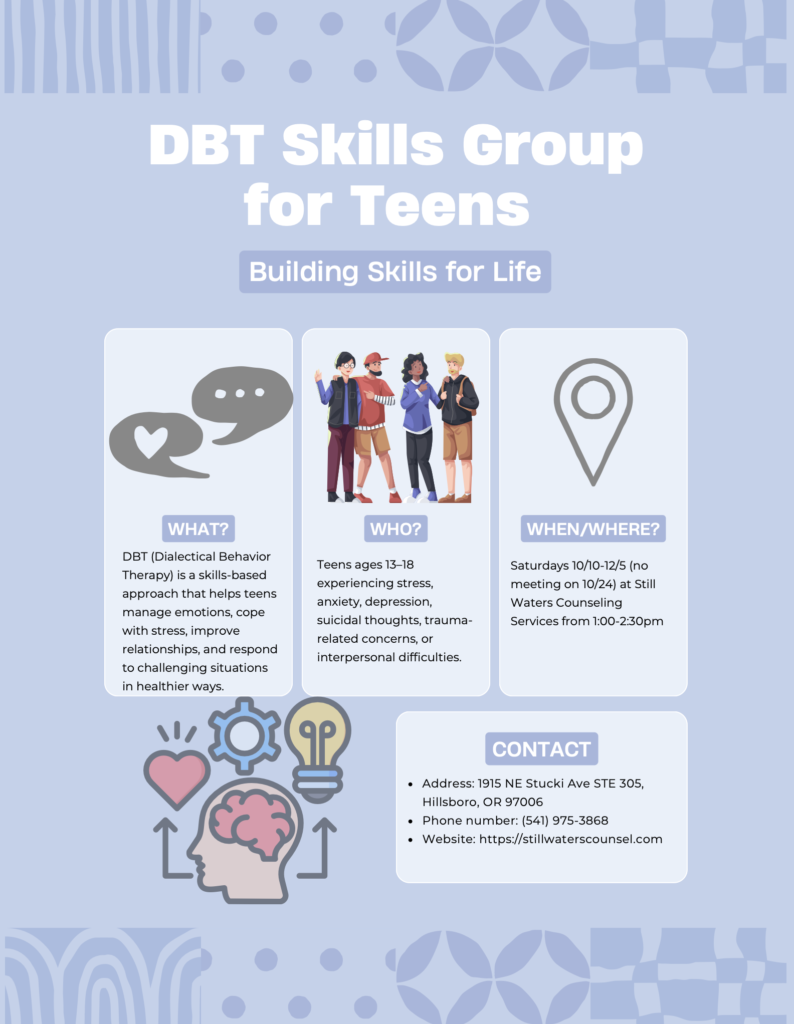
The DBT Skills Group for Teens at Still Waters Counseling gives teens ages 13–18 a structured place to learn practical skills for understanding emotions, coping with stress, improving relationships, and responding to difficult situations in healthier ways.
This in-person group in Hillsboro, Oregon uses skills informed by Dialectical Behavior Therapy, or DBT, and is designed for teens who may be experiencing anxiety, depression, emotional overwhelm, trauma-related concerns, relationship difficulties, or other challenges.
Rather than expecting teens to simply “calm down” or “think differently,” DBT focuses on specific skills they can practice and use in real-life situations.
Who
Teens Ages 13–18
When
Saturdays
1:00PM-2:30PM
10/10 – 12/5
Length
Approximately
90 Minutes
Where
Hillsboro, Oregon
Who Is the DBT Skills Group For?
The DBT Skills Group at Still Waters Counseling is designed for teens ages 13–18.
It may be helpful for teens who are experiencing:
✓ Anxiety or frequent worry
✓ Depression or low mood
✓ Difficulty managing strong emotions
✓ Stress or feeling overwhelmed
✓ Trauma-related concerns
✓ Relationship or friendship difficulties
✓ Conflict with family members
✓ Difficulty communicating feelings
✓ Impulsive reactions
✓ Difficulty coping with challenging situations
✓ Interpersonal difficulties
✓ Thoughts of self-harm or suicide as part of a broader treatment plan, when clinically appropriate
Every teen is different, so participation should be based on whether the program is a good fit for their individual needs. Parents or caregivers can contact Still Waters Counseling to discuss eligibility and available treatment options.
What Is a DBT Skills Group for Teens?
A DBT skills group teaches practical strategies based on Dialectical Behavior Therapy (DBT).
DBT is a skills-focused therapeutic approach that helps people become more aware of their emotions, respond more effectively to stressful situations, and develop healthier ways of communicating and relating to others.
For teenagers, these skills can be especially useful during a stage of life involving changing relationships, academic pressure, family conflict, identity development, social stress, and strong emotions.
Instead of focusing only on talking about problems, the group gives teens tools they can practice during sessions and in everyday life alongside others in a supportive therapeutic setting.
Four Core DBT Skill Areas
Mindfulness
Notice thoughts and emotions without immediately reacting.
Emotion Regulation
Understand emotions and respond more intentionally.
Distress Tolerance
Get through stressful moments without making them worse.
Interpersonal Effectiveness
Build communication, boundary, and relationship skills.
Teen DBT Skills Group in Hillsboro
- Program: DBT Skills Group for Teens
- Age: 13–18
- Format: In Person
- Location: Hillsboro, Oregon
- Address: 1915 NE Stucki Ave, Suite 305
- Session Length: Approximately 90 minutes
- Schedule: Contact the office for availability
Still Waters Counseling
1915 NE Stucki Ave, Suite 305
Hillsboro, OR 97006
What Skills Do Teens Learn in DBT?
DBT commonly organizes skills into four main areas: mindfulness, emotion regulation, distress tolerance, and interpersonal effectiveness.
These skills can help teens develop more awareness of what they are feeling and make more intentional choices about how they respond.
Teens may learn to:
✓ Practice mindfulness and pay attention to the present moment
✓ Identify emotions and understand emotional triggers
✓ Regulate strong emotions more intentionally
✓ Tolerate distress without making a situation worse
✓ Communicate needs and ask for help
✓ Set boundaries and handle disagreements
✓ Maintain self-respect in difficult conversations
The goal is not to eliminate difficult emotions. It is to help teens experience emotions without feeling completely controlled by them, while building practical tools they can use at home, at school, and with friends.
How Can DBT Help Teens Manage Strong Emotions?
Strong emotions are not necessarily a problem by themselves. The challenge often comes when emotions become so intense that a teen has difficulty deciding what to do next.
A teen may feel angry and immediately say something they regret. Anxiety may lead them to avoid school or social situations. Sadness may make everyday responsibilities feel overwhelming.
DBT skills can help teens recognize what they are experiencing before automatically reacting. They can practice asking: What am I feeling? What triggered it? What do I want to do? Will that response help? What other skill could I use instead?
The goal is to build practical skills teens can return to when emotions or situations become difficult.
The goal is not perfect emotional control—it is having more tools to choose from.
DBT for Teen Anxiety, Depression, and Relationships
Anxiety and stress: DBT can provide strategies for noticing anxious thoughts, tolerating uncomfortable emotions, and responding to stress more intentionally instead of immediately avoiding or reacting.
Depression: Depression in teens may appear as sadness, irritability, isolation, low motivation, difficulty concentrating, or disconnection from activities. DBT skills can help teens notice emotional patterns and practice healthier responses.
Relationships: Teens can practice clearer communication, boundaries, handling disagreements, navigating peer pressure, listening to other perspectives, and maintaining self-respect during difficult conversations.
A DBT skills group may be used alongside individual therapy or other mental health services depending on the teen’s needs.
Is a DBT Skills Group the Same as Teen Therapy?
No. Teen therapy usually involves one teen working directly with a therapist, allowing treatment to focus more closely on that teen’s individual experiences and needs.
A DBT skills group focuses on learning and practicing specific coping, communication, emotion-regulation, and relationship skills in a group setting.
For some teens, both may be appropriate. Teen therapy can provide more individualized support, while a DBT skills group offers structured opportunities to practice skills alongside peers.
The right option depends on the teen’s individual needs and treatment plan.
A Practical Skills-Based Approach for Teens
What Happens in a Teen DBT Skills Group?
Sessions are structured around learning and practicing skills teens can use outside the group.
- Learn a new DBT skill
- Discuss where it could be helpful
- Practice applying the skill
- Explore different responses
- Use school, family, friendship, and stress examples
- Reflect on using skills outside the group
- Hear perspectives from other teens
Skills Teens Can Use in Real Life
Teens can practice DBT skills when:
- They argue with a parent
- A friendship changes
- Schoolwork becomes overwhelming
- They feel anxious before an event
- Someone says something upsetting
- They feel an urge to react impulsively
- They struggle to explain what they need
- Strong emotions feel hard to manage
Important Information for Teens in Crisis
A DBT skills group is not a substitute for emergency or crisis care.
If a teen is in immediate danger, has an immediate plan to harm themselves, or cannot stay safe, call or text 988, call 911, or go to the nearest emergency department.
Frequently Asked Questions About DBT Groups for Teens
What is a DBT skills group for teens?
A DBT skills group for teens is a structured therapy group where adolescents learn practical strategies based on Dialectical Behavior Therapy. Skills commonly focus on mindfulness, emotion regulation, distress tolerance, and interpersonal effectiveness.
What age is the Still Waters DBT teen group for?
The Still Waters Counseling DBT Skills Group is designed for teens ages 13–18.
What does DBT teach teenagers?
DBT teaches teens skills for recognizing emotions, managing stressful situations, tolerating distress, communicating more effectively, and responding to challenges more intentionally.
Is DBT good for teen anxiety?
DBT skills may be useful for teens who experience anxiety or difficulty managing stress and strong emotions. Whether DBT is appropriate for a particular teen should be determined based on their individual needs.
Can DBT help teenagers with depression?
DBT may be used as part of treatment for teens experiencing depression, particularly when emotional regulation, coping, relationships, or impulsive behaviors are concerns. A mental health professional can help determine the most appropriate treatment approach.
Does my teen need a diagnosis to join a DBT group?
Eligibility can vary depending on the specific program and the teen’s needs. Parents and caregivers can contact Still Waters Counseling to discuss whether the group may be appropriate.
Is this an online DBT group?
No. The current DBT Skills Group for Teens is offered in person at Still Waters Counseling in Hillsboro, Oregon.
Can parents attend the DBT group?
The current program is described as a DBT Skills Group for teens ages 13–18. Parents should contact Still Waters Counseling directly for information about participation expectations and whether caregiver involvement is part of the program.
What issues can DBT skills help teens work on?
DBT skills may be relevant for teens dealing with emotional regulation, anxiety, depression, stress, trauma-related concerns, interpersonal difficulties, impulsive reactions, or difficulty coping with challenging situations.
Help Your Teen Build Skills for Life
Learning how to manage emotions, cope with stress, communicate effectively, and navigate relationships takes practice.
The DBT Skills Group for Teens at Still Waters Counseling gives teens ages 13–18 a structured environment where they can learn practical strategies they can carry into school, friendships, family relationships, and everyday challenges.
The group is offered in person at the Still Waters Counseling office in Hillsboro, Oregon.
To ask whether the program may be a good fit for your teen, call 541-975-3868 or request an appointment online.